
No, "AI Art" is not Art
A critique of using generative AI to make Art

DISCLAIMER: I am not an Art Expert, I’m just a guy with opinions. Regardless, here’s what I think.
Since AI (Artificial Intelligence) became mainstream in November 2022, things haven’t remained the same. Tech CEOs who want to seem revolutionary won’t shut up about it, students won’t stop using it to cheat in exams, and ChatGPT went from the only app that could generate creative text, to one of many others.
But AI is not really a new thing. It blew up in 2022 but we have been interacting with other kinds of AI for a long time. The “algorithm” that recommends content on TikTok or Instagram or [wherever you get your brainrot from] is AI. AI powers self-driving cars. AI has also been beating professional chess players since 1997. These and many more are applications of AI we have been using.
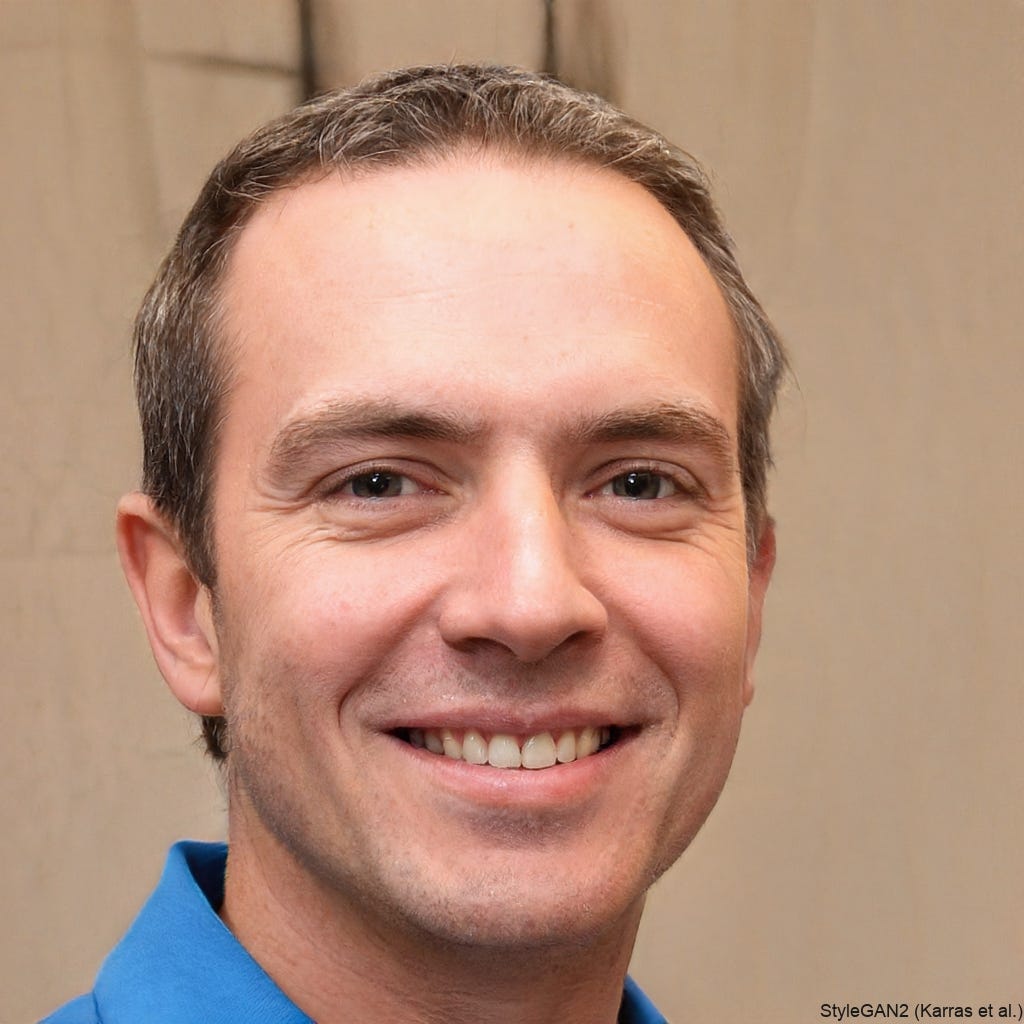
However, this article — which is talking about the implications of AI in Art — is referring to the branch of AI called Generative AI. Generative AI systems are capable of producing realistic-looking text, images, and even videos. Sometimes so realistic you wouldn’t believe they are not real. For example, the person below does not exist. They were randomly generated on a computer.
The mass adoption of AI-enabled the average person to do things that were considered to be in the domain of artists. The average person could now write passages that followed any style (including the style of renowned authors). The average person could create amazing and realistic paintings. The average person could generate music in any genre, all with a prompt (or minimal effort).
While this is fun to play around with, there’s a sentiment floating around that this is real “artistic expression” and that “AI-generated art is Art”. While discussing the question “Is AI Art art?” could surely use some nuance, if I only had to summarize my opinion in one sentence it would be this: No, AI Art is not art.
This article covers my thoughts on the subject, and why I ultimately hold that position. It also discusses situations where AI-enabled output can count as art. Let’s dive in.
What is Art?
Art is the expression of human creativity intended to be presented to an audience that might appreciate it.
A quick search on Google shows that:
[Art is] the expression or application of human creative skill and imagination, typically in a visual form such as painting or sculpture, producing works to be appreciated primarily for their beauty or emotional power.
Source: Oxford Languages
Additionally but perhaps more abstractly, I like to look at art as a manipulation of human emotion. A good artist uses their art to press the “emotional buttons” of their audience. This of course happens with the implicit permission of the audience. For example, people who go to see a horror movie in a cinema are giving the movie producers permission to scare them. People who go to stand-up comedy give the comedian permission to make them laugh, and so on.
Good art is crafted specifically in a way that forces human beings to react emotionally to it. Artists fine-tune their presentation to make sure they milk as much emotional reaction as they can. And the people who do this best are considered the best artists. We are being manipulated by our favorite artists.
From my observation, there are three essential features that constitute good art. These are attributes of every genuine work of art. The features are:
Art needs to come from human imagination (Human Intention)
Executed with skill (Human Skill),
and should trigger a generally expected emotional reaction (Human reaction).
The following three sections will look at these features one after the other.
Human Intention
Not very far from the capital of Japan — Tokyo — lies a unique museum called the Chinsekikan, or the “Hall of Curious Rocks”. It has that name because the museum showcases rocks with very interesting forms. The different rocks are faces that vary from a frown to anger, to a smile.
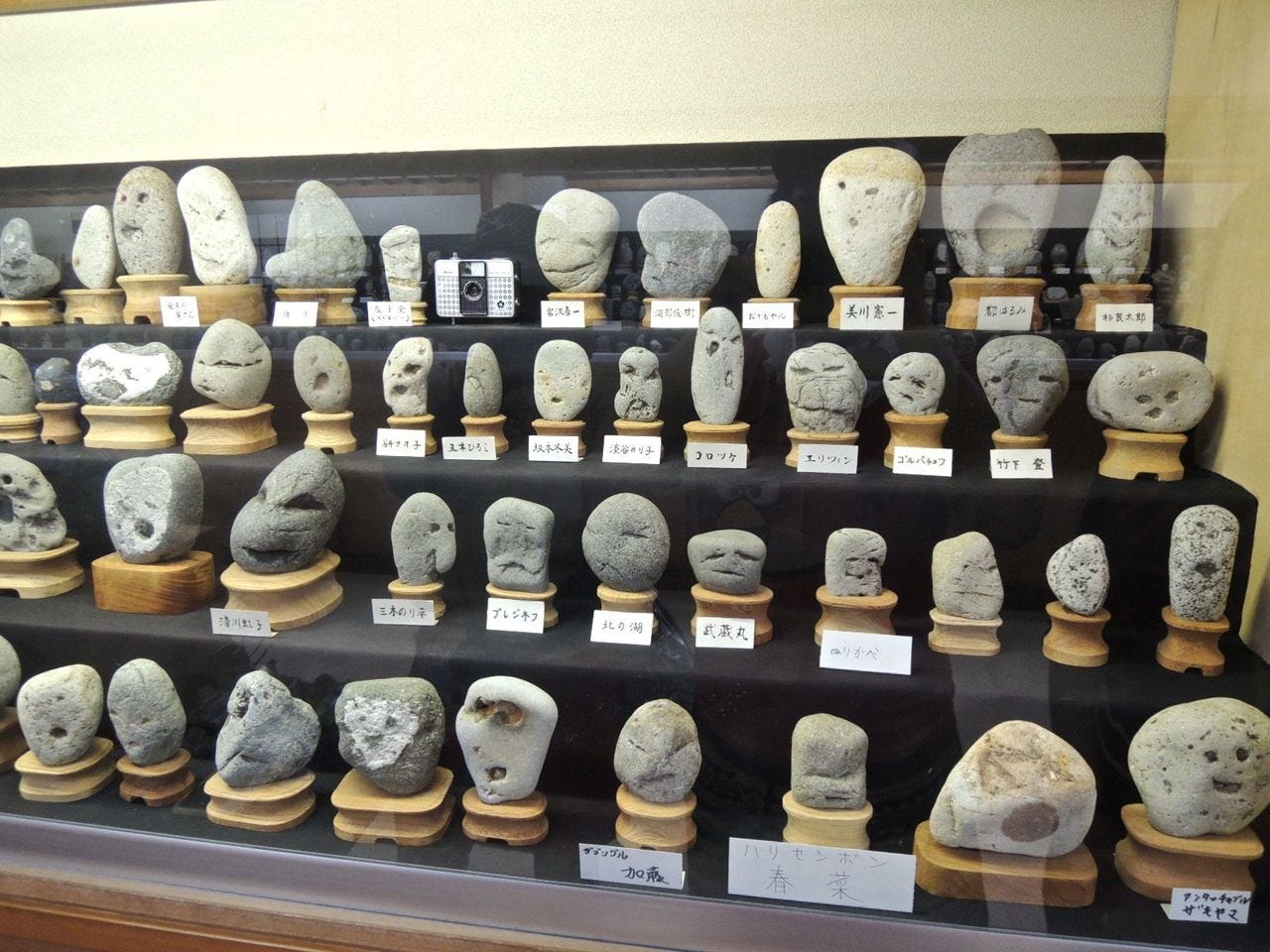
These rocks were not carved to have those faces, but instead, they naturally occurred. All of them. The founder of the museum Shozo Hayama spent over 50 years collecting those rock faces, which are now about 1700 rocks. It’s such a fascinating thing to learn about, no doubt.
However, would you call any of those rocks an art piece?1 According to the features of art this article earlier established, those rocks are not themselves art pieces. 2 The reason is that nobody consciously designed them. In other words, there was no human intention, no creative intent, and therefore no artist.
Human beings are prone to seeing faces or pictorial patterns in inanimate objects, and this phenomenon is called Pareidolia.
Pareidolia can be defined as:
A situation in which someone sees a pattern or image of something that does not exist, for example a face in a cloud
Source: Cambridge Dictionary
Pareidolia is a fairly understood feature of human psychology. We see faces and patterns everywhere. It is what attracts tourists to those rocks, and what made Mr. Hayama start picking them up. The implication of this is that something can be beautiful, attractive, or symbolic without being art. 3
For a piece to be art, it has to come from the human imagination. Nature does not have human (or even a conscious) imagination — according to what we know so far. Therefore, nothing nature does should be counted as art.
“AI Art” is initiated by human beings (people come up with a vague idea of what they want and write a prompt for it). So, going by that requirement alone generative AI will be considered as art. However, there are two more properties art needs to fulfill.
Human Skill
Popular contemporary artists are highly compensated for their craft. This is because they generally provide a service that is in high demand. Most people in a given large population cannot make art in the taste they have come to expect from big artists, because artistic talent is not equally distributed in a society. Not everybody can be an artist.
Human Skill is important to make art. The point of art, what makes it alluring and captivating is that the average person cannot do it given the same set of resources. That is why art has so much power over us. Because it comes from human ingenuity. There is no step-by-step guide to constructing good art. There is no formula for quality art. Artists just tinker with materials and hope people react accordingly to it.
If eventually there is a formula for creating a particular type of art, such that a lot of people reproduce it, then that art form loses its appeal. Art thrives when it is not very easy to reproduce. Artists usually need to be steps ahead of their audience. It is the only way they get to impress the audience and make them value a piece.
Human Reaction
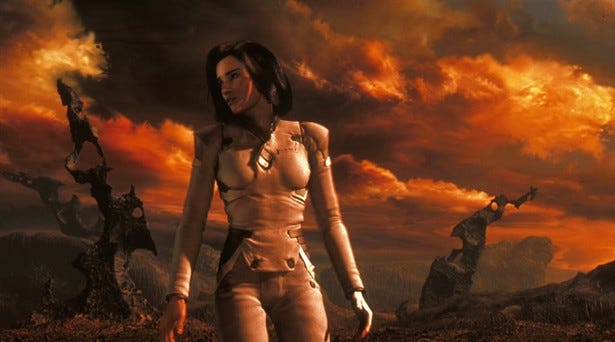
The image above is a shot from the film Final Fantasy: The Spirits Within. I have not seen this movie, but I have read a lot about it. What drew me to it was that it was one of the earliest computer-animated movies in cinema. I learned about the movie years ago when I wanted to become a computer animator. 4
There are a couple of fascinating things about this movie. First, it was made with the high-end budget of $137 Million in 2001. For context, the average Hollywood movie cost $48 Million to make that year. So, this movie costs almost 3X the budget of the average movie.
Secondly, it was the first ever photo-realistic animated film. This unprecedented movie took a lot of labor to pull off — It took a staff of 200 people about 4 years to make the movie. The point I’m driving home is that Final Fantasy was a big deal in 2001. It was going to offer something unique and special. It was going to be a blast and it was going to be loud.
Sure enough, it was a loud bomb. By that I mean it literally bombed at the box office. The movie flopped, as it could not get enough viewers to go see it in cinemas. Final Fantasy finished the rounds in the cinemas by grossing a meager $85 Million. 5 Embarking on creating the movie ended up being a huge loss operation that the studio behind it was never able to recover from. 6
Was Final Fantasy art? Well, it was, but it was low-quality art. The reason for this is not because effort was not put into it. There was a lot of effort. The reason is that the audience generally did not react to it as anticipated.
In order for art to be of quality, it needs to trigger emotional reactions anticipated by the creator. If a song is supposed to be sober, and vulnerable, but most of the audience who listen to it do not sense that, then the art has failed. Final Fantasy was supposed to be a mind-blowing epic, but that wish unfortunately did not materialize.
Now, art is subjective and some people might “get” an artwork better than other people. However, as a rule of thumb, a good score for the effectiveness of an art piece is the percentage of the audience who actually felt what the artist wanted them to feel. The skill of an artist is how expertly they can manipulate a large chunk of their audience into reacting in a generally expected way.
Why is “AI Art” not Art?
There are many reasons why art may fail. Maybe the artist did not have enough skill, maybe the artist presented it at the wrong time hence getting negative reactions, or maybe the audience thought the artist had bad taste. These and many others are among the reasons.
But why does “AI Art” in particular fail? why is “AI Art” not art? Well, my short answer is this: because it is not impressive. Art is supposed to be impressive. Creating good art should be something slightly out of reach for the average person, and good art should feel special when presented.
Art is a labor of passion, intention, skill, and obsession with details. Artificial Intelligence offers none of that. There is nothing impressive about typing a prompt into a computer to come up with visuals (regardless of how mind-blowing the visuals are).
There is something impressive about drawing photo-realistic images with a pen. That’s art. There is something impressive about writing emotionally moving songs, performing profound poetry, telling jokes that land, and so on.
The only impressive thing about generative AI is the engineering that made it capable of generating such output. Nobody is impressed with the skill of the prompter. People who prompt generative AI systems should not call themselves artists for doing that. It’s disgusting.
Good artists are inventors who come up with new ways to get our emotions stirred. They usually need to take risks, be experimental, and be daring. If the audience happens to resonate with a new experimental piece then it pays the artist. If not, then at least the creator still has the mind of an artist. Final Fantasy might not have made brilliant art, but its creators definitely had the right attitude.
“AI Art” is not Art, or at least it can never be good art because it does not fulfill all the qualities of good art. In order to make good art, an artist needs to lead with intention, possess the skills to pull it off and have the audience receive it how they intended. “AI Art” requires little to no skill. Because of this, once the entire process of AI work is revealed, the audience is no longer that impressed with the prompter.
Can we at least make Art with AI?
I suppose there is a possibility to make good art in collaboration with AI tools. However, it is very important that the artists put in the majority of the effort, not the tool. A good rule of thumb for creating impressive art is this: would the average person tossed in this exact scenario be able to produce art close to the one the artist produced? If yes, then the artist needs to try harder.
If an artist is working with AI, then the artwork should be good in spite of AI, not because of it.
Also, the ubiquity of these AI tools has shown that quality art (in order to be distinct from AI-generated slop) needs to have a lot more personality and be messy. Quality art also needs to reach into our collective depths of human consciousness, communicating so profoundly that AI tools will have a hard time catching up.
I really enjoyed the Grammy-nominated album HEIS by Rema. The chaos and personality Rema brought to the album is something that AI does not look like it can replicate anytime soon.
Going forward as an artist, if your artwork can pass for an AI-generated piece, then that is an insult to your artistry, and you have fucked up.
And if you would then who is the artist?
The artistry lies in the discovery, curation, and presentation of the rocks. Not in the rocks themselves.
It also means that human beings — with their physical form and mental capabilities — are not “a work of art”. At least that would be the case if you agree with the Darwinian theory of evolution by natural selection, like I do.
Till I discovered I could not draw to save my life, which is an essential skill in animation.
Of course, $85 Million was still a lot of money in 2001 (and even today), however, compared to the amount spent making Final Fantasy, it was not nearly enough.
The studio eventually shut down, with the loss Final Fantasy made being one of the big reasons why.